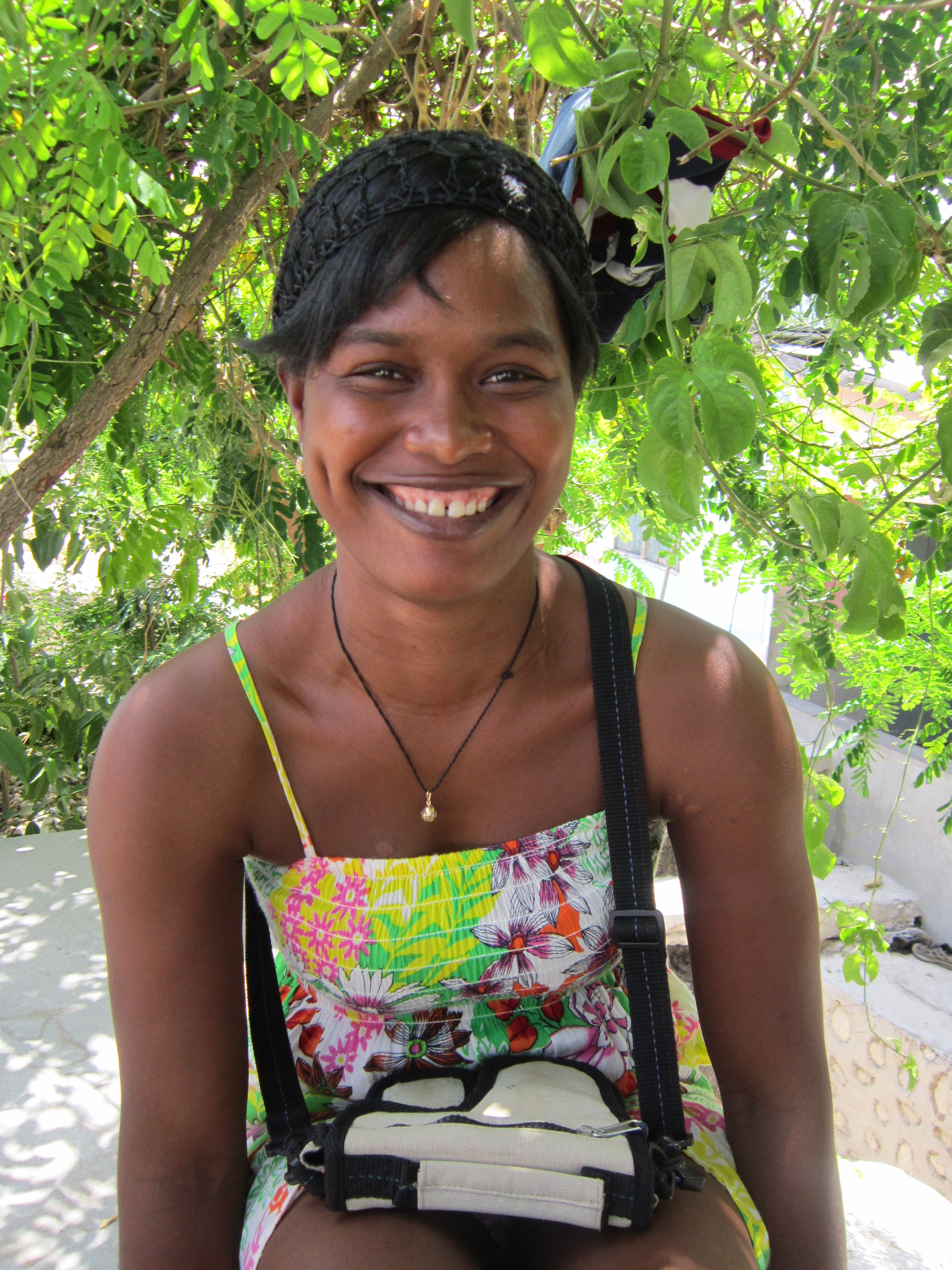
HFF Employee Profile: Jeta

HFF Employee Profile: Jeta

i Jan 30th No Comments by

When we met Jeta in April of 2010, the mother of two was struggling. Her partner and father of her children had left her, she had lost her job, and she was struggling to feed her eighteen-month old son, Kervens. Jeta knew how painful a separation from Kervens would be: she’d already placed her daughter Gloria with another family member an hour away in Port-au-Prince. After talking with Jeta, it was clear to us that this was a mother who was willing to work hard to take care of her family, but who needed a hand up, a little bit of support to achieve self sufficiency.
We went to work trying to assess what skills Jeta had to help her achieve that goal, and soon discovered that she was the perfect HFF jack-of-all-trades: someone who could help others in many of the ways HFF does.  Jeta serves as a nanny to the children we take into care temporarily and as a cook for families who stay with us while they’re in Port-au-Prince getting medical care, etc. for their children.  She visits the families of new babies who need encouragement, and she spends many hours in the hospital – comforting abandoned infants until a solution can be found for them, holding the hands of sick children, and helping their families advocate for their children’s care.
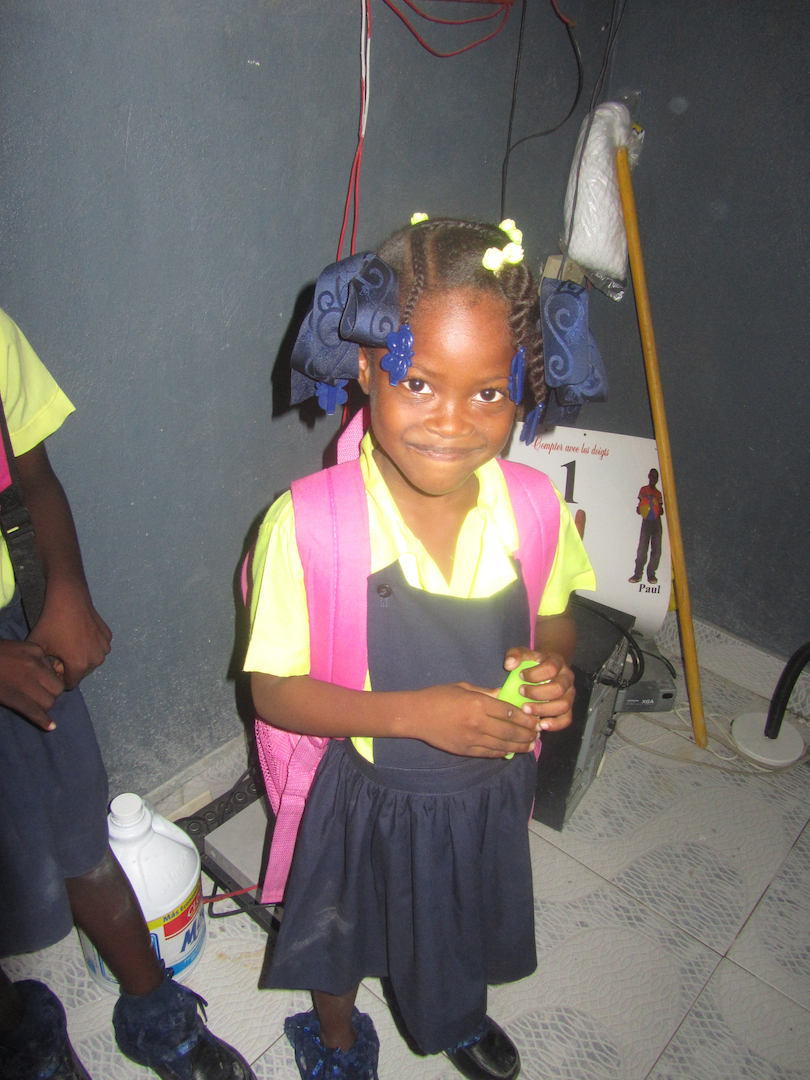
Having a stable and steady income as an HFF employee, Jeta no longer struggled to feed her young son, and was even able to enroll him in his local pre-school. When we asked Jeta what her most important goal was, she of course responded that she would like to return her daughter Gloria back home, and have the opportunity to parent both of her beautiful children once again. We helped Jeta make arrangements for Gloria to travel home from Port-au-Prince, and she settled back into her home where she belongs – as a big sister to Kervens, and a daughter to Jeta.

Gloria is flourishing in the first grade, proud of the chance to go to school, something she never thought would be possible. She is a responsible big sister to 3 year old Kervens, and it is clear that she enjoys having the rambunctious, loving little guy around. Kervens loves his mom more than words can describe. Sometimes when he is upset he calls her ‘Jeta!’ which always takes people by surprise – he has a BIG personality . He will beg to take a ride in the car with us, but if it takes him too far away from Jeta, he is no longer interested. He wants to be close to his mom.
Jeta, Gloria and Kervens are a beautiful HFF family, one that supports countless families in their community by being a shining example of what positive change can come to those who are struggling  with a little bit of support from a caring neighbor.


Are you a Changemaker?

i Jan 23rd No Comments by

By Vivian Lee Croft

After graduating high school I wanted to join the Peace Corps. Then, I wanted to teach English in Nepal. Now, I want to help strengthen a country, one family at a time. And that, I can do.

You might laugh at the seeming impossibility of how these things help or even, how one person can make a difference, moreover, has the passion or will to do so. The common thread through all of these desires and likely everyone following the dream to dedicate his life to service, is the explicit need to help other people.

Reflecting on the first few weeks of this year, the anniversary of the earthquake in Haiti, the annual celebration of the Rev. Dr. Martin Luther King, Jr., and my own personal accomplishments and losses, I believe nothing but change will propel me forward. And in changing my personal belief system to include the understanding that my actions matter, I embrace being called a changemaker. Just knowing that I can lead by example, or give one extra dollar or enhance someone’s life with education, leads me to believe that I am changing the world. These are small steps, simple ones that start at home, with me.

My dad taught me the importance of leading by example, staying true to my word, honoring my relationships, and fighting for that in which I believe. Genetics or upbringing, he is the reason I give so deeply and so passionately. As I provided care for him at my parents’ home, my childhood home during his battle with cancer eight years ago, I was able to connect with him in a way that has since impacted my view of life and death. He died at home, with dignity, with my mom and me at his side. His death rocketed me forward in wanting to really dig deep and help others. When Jamie and Ali and I talk about the families in Haiti served through our programs, I often think of his final week under my care. I know how it feels to lose someone. I know what a blow it is to have to see cancer take down a giant of a man. I know that education and prevention are key (but not the only) components in proper health care and this is something that translates over borders.

This week, Jamie is hoping to finalize a date for a surgery in the US for Junior, a child in Haiti who cannot get the life-saving operation he needs there. This is his last chance. I hope that I am able to honor my relationship with HFF and Junior’s family by fighting for them, because I believe in them. My hope is that Junior’s father will not have to know the sorrow of losing his child. By leading by example, giving an extra dollar, and offering education in whatever form that comes, I am contributing to the change I know I can see.

Some people talk about dreams. Big dreamers plan for change. Changemakers institute it. If the Rev. Dr. Martin Luther King, Jr. didn’t talk about his dream, he wouldn’t have inspired countless others to help him change the world. My dream is for us to change the world. Let’s help Haiti grow to mirror the hearts of its people, who engage with love and hope. Let’s reach out and be changemakers.

You too can be a changemaker, maybe you already are. I’d love to hear how. Send me an email at vivian (at) HaitianFamiliesFirst dot org or tweet us at @HaitianFam1st and tell us how you change your world. We’d love to be inspired by your efforts and will share them with everyone else so that they may be inspired, too. #GiveUp2GiveBack
Vivian Lee Croft is a member of the Haitian Families First Board of Directors.  Vivian lives in Pittsburgh and is a graduate of Duquesne University.  Her chief roles are programming and development for the organization.  To get in touch with Vivian, please email her at vivian@haitianfamiliesfirst.org.
Reflection: the 2010 Earthquake in Haiti – Part 2

i Jan 16th No Comments by

If you haven’t read Part 1 of the story, click here to read it first.

Part 2

The shaking finally stopped. After a few seconds, Jamie and I agreed that it was an earthquake that had just happened, and that it seemed to be over. We looked around to see everyone still screaming, crying, praying, and now most people holding a cell phone to their ear, trying to get through to their loved ones. A man stood close by outside of Jamie’s window. He had an iPod, and had one of the headphones in his ear, the other ear empty. He noticed our sense of panic (which, of course, everyone shared) and mouthed the words (in kreyol) ‘are you guys okay?’  Jamie put her window down and said ‘Yes, it seems like it, are you?’ He looked around, and shrugged his shoulders. Jamie said ‘What happened? What was that?’ He replied ‘An earthquake. There has not been an earthquake in Haiti for over 200 years, but that was an earthquake.’ We asked ‘Are you sure? An earthquake in Haiti?? Is it possible?’ He said yes. I started to cry. He leaned in to the window and said ‘You don’t have to cry honey, you are alive, and everything is going to be okay. Do you have any place you can go?’ We told him the closest place was our friends house, normally a two minute drive from where we were. He repeated ‘Everything is going to be okay, you don’t have to cry.’ When just a few minutes later traffic started moving, we looked at him and he nodded and said ‘Go, be safe.’

We made the decision to turn off of the main road to take the quickest route to our friends house, even though houses were still falling and the roads were chaotic, many of them completely blocked by fallen poles and debris. We made the right turns, and ended up on a road we knew. During the whole drive, I had two cell phones and was dialing someone at our friends house on one of them, and the nurse at the orphanage on the other one. I could not get through, it wouldn’t even ring. Jamie and I talked the whole drive about what was going on. I commented that no one in the entire country had any control at that moment – it didn’t matter that we had police, UN soldiers, nobody could have known what to do in those first moments.

I felt like I was gasping for every breath, and Jamie remained incredibly calm, driving through narrow spaces, past people missing limbs, one woman missing her face, but screaming for help. A woman banged on our window asking for help, holding a baby in her other hand that had just been born, still connected by the umbilical cord. There was nothing we could do for anyone. Jamie said everyone in our house is dead, our house fell, the kids are under the house. I said no they are not, no it did not, everything is going to be okay, everyone is okay. We couldn’t get through on the phone to find out what was true. Finally, I first got through to the nurse who told me that everyone in our house was alive. The house had not fallen down completely, only a part of an outside area, and everyone was outside in the driveway. I told her to stay there no matter what, that I didn’t know when I would get through by telephone again, or when or how we would get home, but to stay outside until we got there. We were driving down the street right next to our friends house and it seemed like every single house had fallen, dust and dirt filled the air, arms and legs were sticking out of almost every house. Jamie and I both started to cry, feeling like we were going to pass our friends house and see the exact same thing.

It is hard to describe how terrifying that feeling was. A minute later I got through to the friend, he told me everyone in their house was okay, the house was still standing, they were outside, where were we? I told him just a minute away. During the end of the drive, a person in the states sent a text that said ‘7.3 magnitude earthquake in port au prince! are you guys okay??’ I wrote back a quick ‘everyone is alive, nothing is okay. dead people everywhere. we are so scared.’ After that text, my prepaid cell phone minutes ran out, and I couldn’t call anyone else. He was able to get through by calling though, and I explained to him what had happened so far, crying to him that we were so scared and didn’t know what to do. I asked him to call my mom and start to get the word out that all the kids at our house were alive and seemed to be ok. It took us about ten more minutes to get there, and we parked the car and got out to stand on the sidewalk.
We all had an excruciating headache. I had some advil in the glove compartment in the car, and passed two out to everyone standing around. We all stood watching the street as the traffic gridlocked, and stayed that way for several hours. About ten minutes after we arrived, every single car was filled over capacity with victims of the quake. People were literally missing arms and legs, hands, feet, scalps, everything you can think of. They seemed to be headed to the hospital, but how? And were the hospitals even standing? At that point, no one had any idea. I was finally able to use my other cell phone to call an American living at the other house of the orphanage, and found out that everyone in all of the houses had survived, and that the houses were all still standing, but badly damaged. We stood in the street for a few hours. The first aftershock set in the feeling of intense and real fear, fear that the worst might be yet to come, that what had happened had changed all of our lives forever and ever, and that we were the lucky ones to even still be alive. The aftershocks came again and again over those few hours.

The traffic had cleared, and a few friends ventured out to see what the main roads looked like, and which streets had been closed. They came back and told us it was going to be impossible to get back to our house, that most of the roads were blocked by UN trucks and troops, or were full of people sitting or sleeping in them. We knew we had to get home, we had to be with the kids, we were so so scared to drive. What if another aftershock came while we were in our car? Why had we survived the quake while in our car, why didn’t it tip over? Would we have the same luck if it happened again? Our friend agreed to come with us and drive the car, so we nervously jumped in and started the drive home. This was the first time we saw what things had fallen, what things had stayed up. We drove on the wrong side of the road sometimes when roads were blocked by cars or people, we took all back roads that we thought would be the safest, and arrived home fairly quickly.

We found all of our kids lying on blankets in the driveway, with their nannies sleeping around them forming a barricade. About half of them were sleeping, the rest sat quietly looking around, some of them cheered when they saw that we were home. We found our nurse in a teary panic because her brother had been in his afternoon college class at 4:53… and he hadn’t come home yet. It was dark, it was night time, there was no electricity, there was nothing we could do but wait until daylight, and of course we had no idea what we would do when it came. But the light of day would at least make the shaking a little less eerie, a little less terrifying.